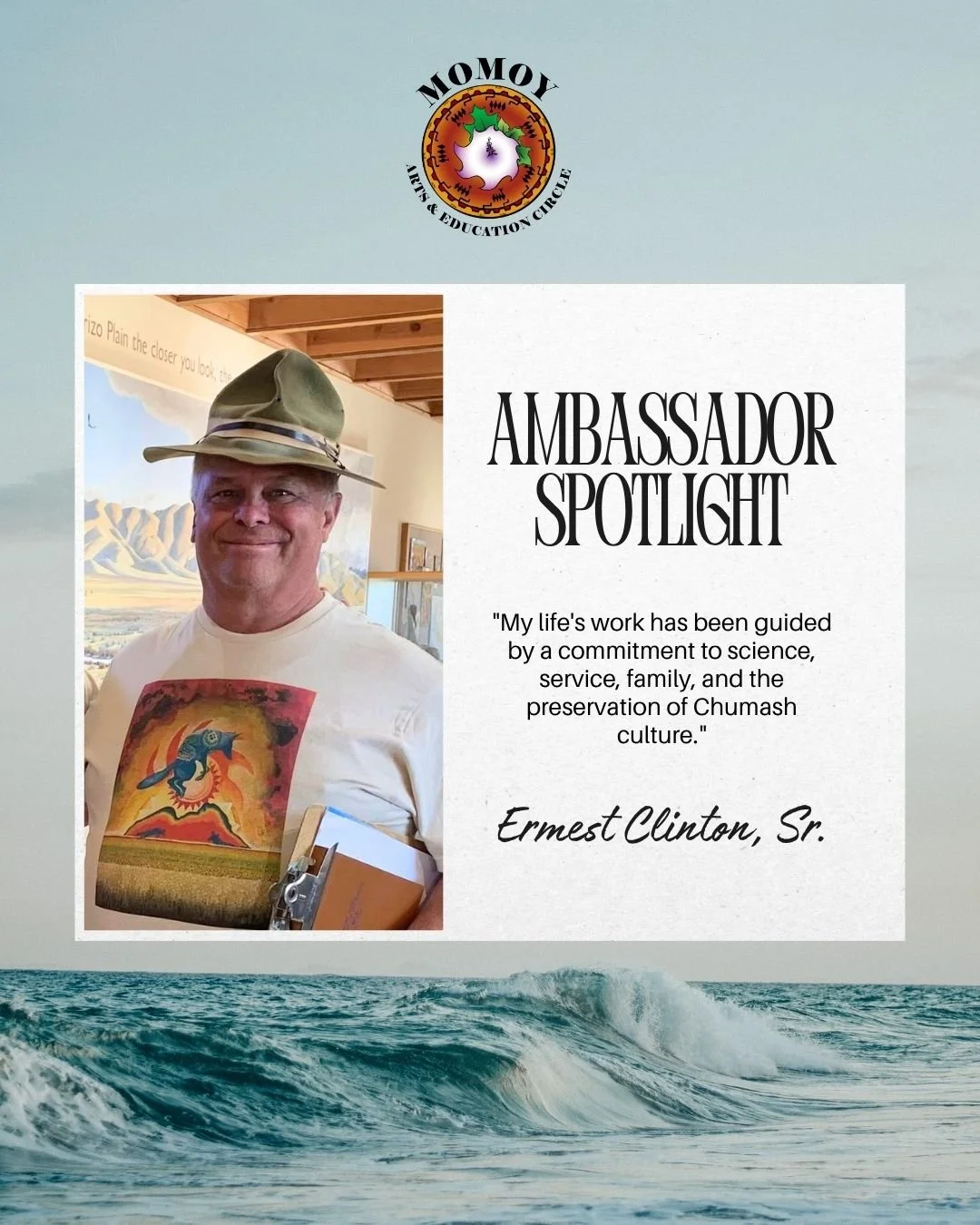
Ambassador Spotlight: Ernie Clinton
Editor’s Note / Guest Author Introduction:
We are honored to share this personal reflection from Ernie Clinton, Sr., a Chumash descendant, Tribal Cultural Resource Monitor, USGS scientist, veteran, and active participant in the Tomol Culture Ambassador Program. In this spotlight, Ernie reflects on his personal journey—from growing up on California’s Central Coast and serving his country to protecting ancestral lands and passing cultural traditions down to the next generation. Here is Ernie’s story, in his own words.
I am a Chumash descendant through my mother, Frances, whose lineage traces through Ernest Gallego-Galloway and Pacifico Gallego. I am also an enrolled member of the Coastal Band of the Chumash Nation. Born and raised in Santa Maria, California, my connection to the Central Coast landscape and its cultural heritage has shaped both my personal and professional journey.
Growing up, I expected to follow my father into the oil fields, where he worked as a truck driver. Higher education was not something I envisioned for myself as a young person. That changed when I attended Allan Hancock College and was introduced to geology, a field that immediately captured my interest. I eventually earned a Bachelor of Science degree in Geology from California State University, Sacramento.
While attending CSU Sacramento, I met a scientist from the U.S. Geological Survey who encouraged me to apply for the Minority Participation in the Earth Sciences program. Being accepted into that program opened the door to a rewarding 34-year career with the USGS. As a technical scientist, I studied groundwater aquifers, rivers, reservoirs, hydropower systems, floods, wildfires, debris flows, and the movement of river sediments to coastal beaches. My work took me throughout California, including the Salinas, Mojave, Santa Ynez, and Santa Clara River basins. During this same period, I also served six years in the California Army National Guard as a tank crewman.
Today, in retirement, I continue to serve my community as a tribal cultural resource monitor. I work with federal, state, and local agencies, as well as archaeologists, biologists, planners, and university researchers, to help protect Chumash cultural resources during construction and development projects. My role involves monitoring ground-disturbing activities in areas where cultural materials, ancestral remains, or significant cultural landscapes may be present. I strive to foster respectful communication among project teams, construction crews, and tribal representatives while ensuring that the integrity and dignity of our cultural heritage are protected. My background in geology remains invaluable in this work, allowing me to interpret soils and earth materials, document excavation and trench profiles, and assist in making informed field decisions when cultural resources are encountered.
Family has always been central to my life. As a working single parent, I raised two sons, Ernest Clinton and Henry, who remain a source of great pride. My eldest son, Ernie, served in the United States Marine Corps and completed combat deployments to Iraq and Afghanistan. Supporting him through those years deepened my appreciation for service, resilience, and family bonds.
Today, Ernie and I share another important journey as active participants in the Tomol Culture Ambassador Program. Together we have helped build, repair, and paddle tomols, participated in cultural ceremonies, and developed meaningful friendships within the Chumash community. Through these experiences, we continue to learn about our heritage, traditions, spirituality, and connection to the ocean. This path of cultural exploration has strengthened our father-son relationship and enriched our understanding of who we are as Chumash people.
In addition to my work in cultural resource protection, I was actively involved in the successful effort to secure federal designation of the Chumash Heritage National Marine Sanctuary, a landmark achievement that recognizes and helps protect the cultural, historical, and ecological significance of California's Central Coast. This designation represents an important step in preserving a maritime landscape that has sustained Chumash communities for countless generations. Today, I am fortunate to live adjacent to this newest addition to the National Marine Sanctuary System, where I can continue to strengthen my connection to the ocean, our ancestral waters, and the cultural traditions that remain an integral part of Chumash identity.
My life's work has been guided by a commitment to science, service, family, and the preservation of Chumash culture. Whether in the field as a geologist, serving in the military, or protecting cultural resources today, I remain dedicated to honoring the land, the history it holds, and the generations who will follow.
—Ernie Clinton, Sr.